Hotel wall art is no longer an afterthought. Across 2025 and 2026, art has become a deliberate part of the guest journey — from the first impression in the lobby to the room a guest wakes up in. This guide covers 12 approaches across every hotel space, from budget-boutique to luxury, with practical guidance on what works and why.
The commercial case has never been stronger. Guest satisfaction data drawn from tens of millions of reviews consistently shows that perceived quality — including the visual environment — is among the most immediately legible signals a guest responds to before a word is exchanged with staff.
This is also a companion piece to our broader Boutique Hotel Wall Art guide, which goes deeper on independent and design-led properties specifically. This guide covers the full range of hotel types and every space within a property.
Why Hotel Wall Art Affects Guest Reviews and Revenue Directly
The Shiji ReviewPro Guest Experience Benchmark, drawing on 39 million reviews across 11,200 properties and 61 platforms, establishes that perceived quality is the primary determinant of guest satisfaction — and visual environment is among the most immediately legible quality signals a guest has available before checking in.
Art is the most visible evidence of that quality signal — present before a staff member speaks, before a pillow is evaluated, before a menu is opened. A lobby print that reads as considered communicates investment in the guest experience; a corridor of identical generic prints communicates the opposite. In-room hotel wall art specifically was long treated as an afterthought — neutral, forgettable, designed to fill space rather than contribute to it. That’s changing across the industry as hotels shift toward more personalised, identity-driven guest experiences.
Hotel Wall Art for the Lobby — the First and Most Lasting Impression
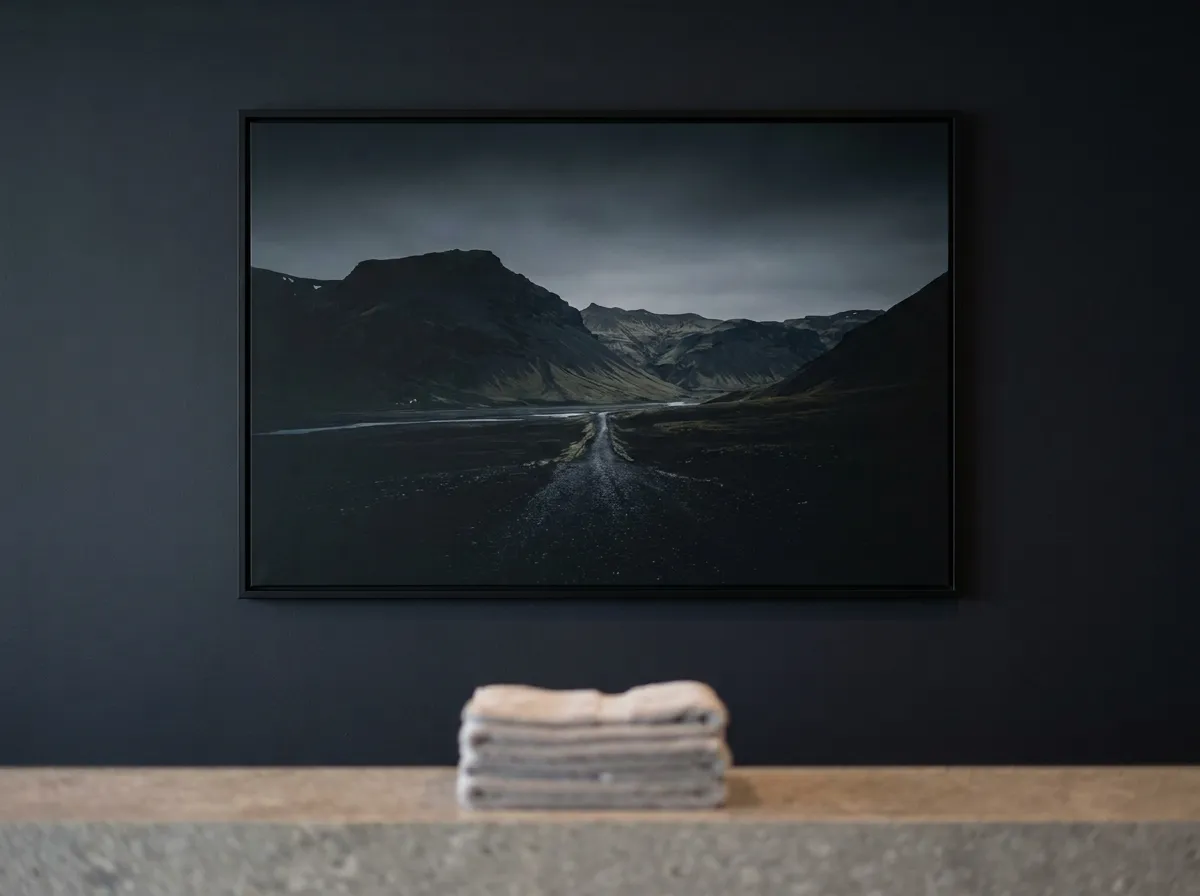
The hotel lobby is the space where every guest’s experience is framed. Lobbies have expanded well beyond check-in — they now serve as places to eat, drink, work, and meet — and as that function has broadened, hotel wall art in the lobby needs to perform across a wider range of viewing contexts and durations than at any previous point in hospitality design.
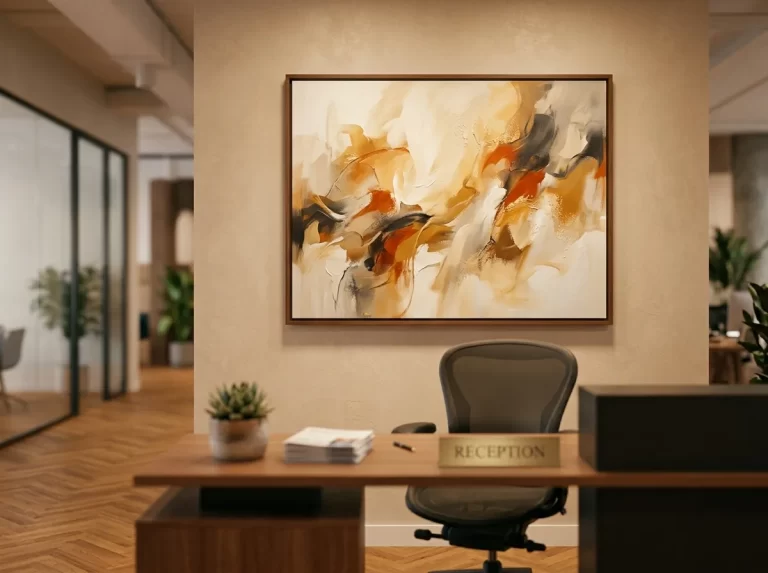
Large-scale statement pieces are the dominant approach for 2025–2026 lobbies. A single confident print on the primary lobby wall does more to establish a property’s visual identity than any combination of smaller pieces — it’s what guests remember, what they photograph, and what sets the register for the rest of the stay.
Technique choice communicates brand positioning immediately: Gilt Edge Canvas signals premium and atmospheric; Silver Grain Film signals editorial and design-led; Botanical Meadow signals warm and approachable. The hotel wall art in the lobby is the property’s aesthetic statement, visible before a word is exchanged.
Guest Room Hotel Wall Art — the In-Room Experience
Guest room hotel wall art is the most intimate application of art in a hotel — the piece a guest lives with for the duration of their stay, wakes up facing, and photographs as part of their experience of the room. Guest rooms are increasingly designed with sleep quality and stress reduction in mind, and materials — including art — are chosen for how they affect mood and comfort, not just for visual effect.
The brief is specific: present enough to communicate quality, restrained enough not to intrude on rest, neutral enough to suit every guest, and distinctive enough to be remembered. This rules out the identical landscape prints that appear in thousands of properties worldwide, in favour of technique-based choices with genuine tonal depth.
Above-bed hotel wall art should span 75–80% of the headboard width — the same rule that applies residentially. Muted Canvas prints — deep tonal, desaturated, warm — perform consistently well here across different room sizes and guest profiles because they read as quality without making a strong personal statement. See our Bedroom Wall Art Ideas guide for deeper sizing guidance.
Boutique Hotel Wall Art That Communicates Identity and Story
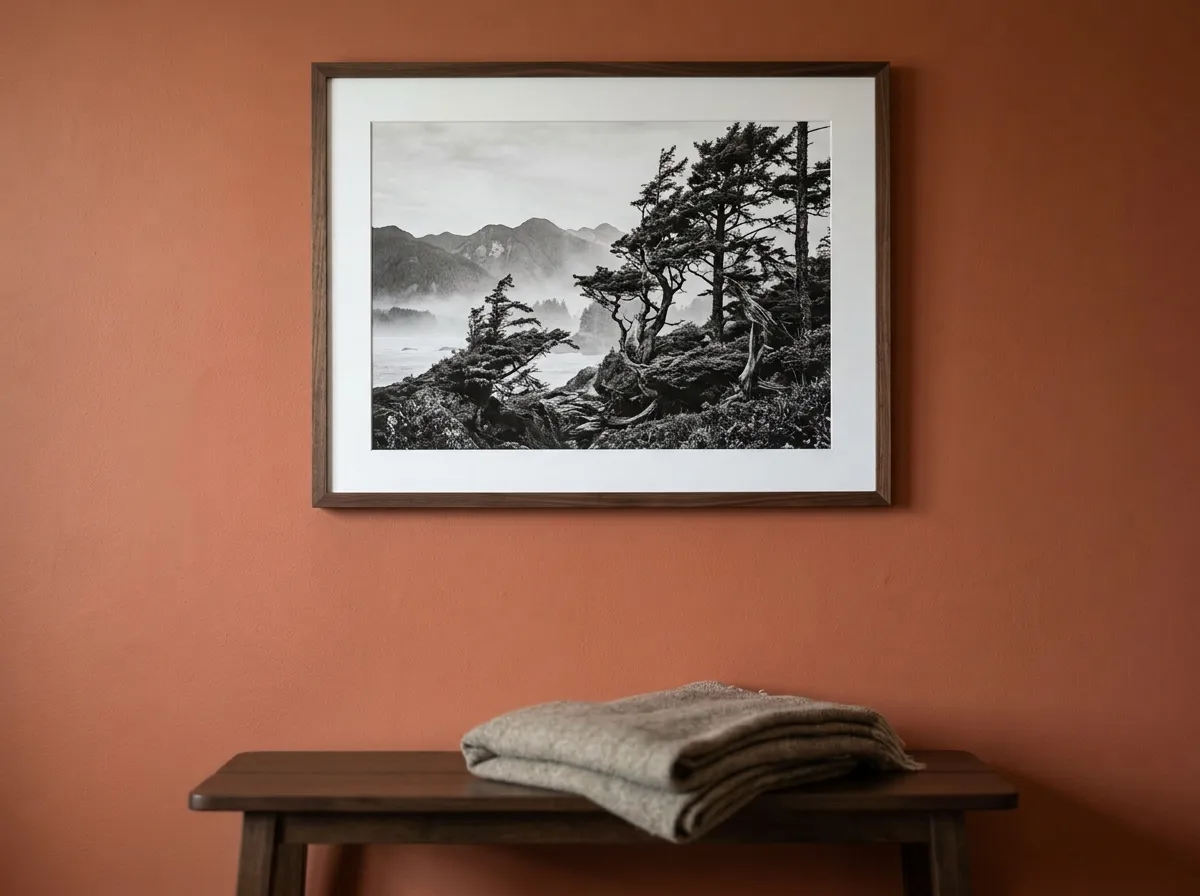
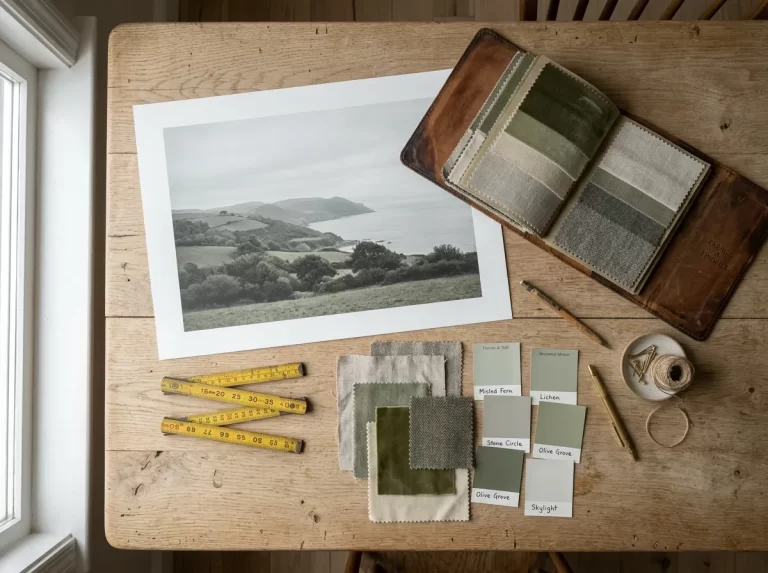
For boutique hotels, the most commercially valuable hotel wall art brief is art that tells a specific story about a specific place. A coastal boutique hotel with monochrome prints of the local coastline — not generic coastal imagery, but specific landscapes from the property’s immediate environment, rendered in a technique that elevates them beyond documentary photography — communicates a depth of local knowledge that generic hotel art cannot.
Digital download hotel wall art makes this practical at manageable cost: a series of locally inspired prints across multiple rooms and public spaces, printed at scale from the same files, creates visual consistency and narrative coherence at a fraction of the cost of commissioned original art.
Hotel Corridor Art — the Overlooked Guest Journey
Hotel corridors are the most consistently neglected spaces in hospitality art programmes — and among the most frequently experienced. A guest walks the corridor from elevator to room multiple times daily throughout their stay. The cumulative experience of that corridor — its art, its atmosphere — contributes to the overall quality impression in ways that are rarely quantified but consistently felt.
Effective corridor hotel wall art follows a different logic from lobby or guest room art. The viewing context is motion — guests walking at pace, glancing sideways, rarely stopping. This calls for strong silhouette clarity and legible visual identity at a glance: a single dominant subject against a tonal background, not a complex composition that requires sustained attention.
A consistent series of same-technique prints at consistent height and spacing creates the rhythm that makes a corridor feel designed rather than incidentally filled. Inconsistent spacing or random height variation reads as accumulated filling.
Hotel Restaurant and Bar Art — Atmosphere at Social Distance
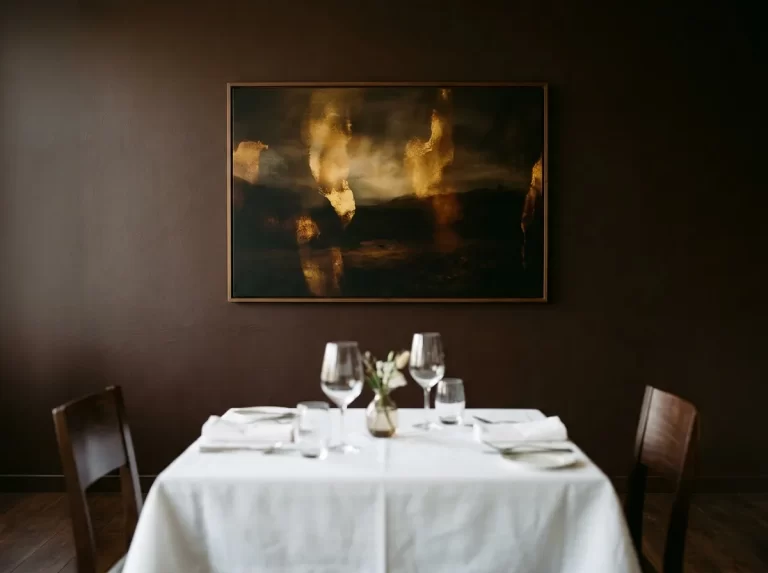
Hotel food and beverage spaces — restaurant, bar, breakfast room — are where hotel wall art performs at the largest scale and under the most demanding lighting conditions. These spaces are experienced at social distance, under warm artificial lighting at low to medium intensity, for extended periods during which the art becomes part of the ambient experience of the meal.
Deep greens, earthy oranges, and rich golds dominate current hospitality palettes, complemented by classic neutrals for balance. Hotel wall art in these spaces should share that palette: Gilt Edge Canvas prints with warm gold accents read as premium under restaurant lighting; Muted Canvas landscapes in deep tonal range read as atmospheric and sophisticated. See our dedicated Wall Art for Restaurants and Cafes guide for full sizing and placement guidance.
Hotel Spa and Wellness Wall Art — Nature for Recovery
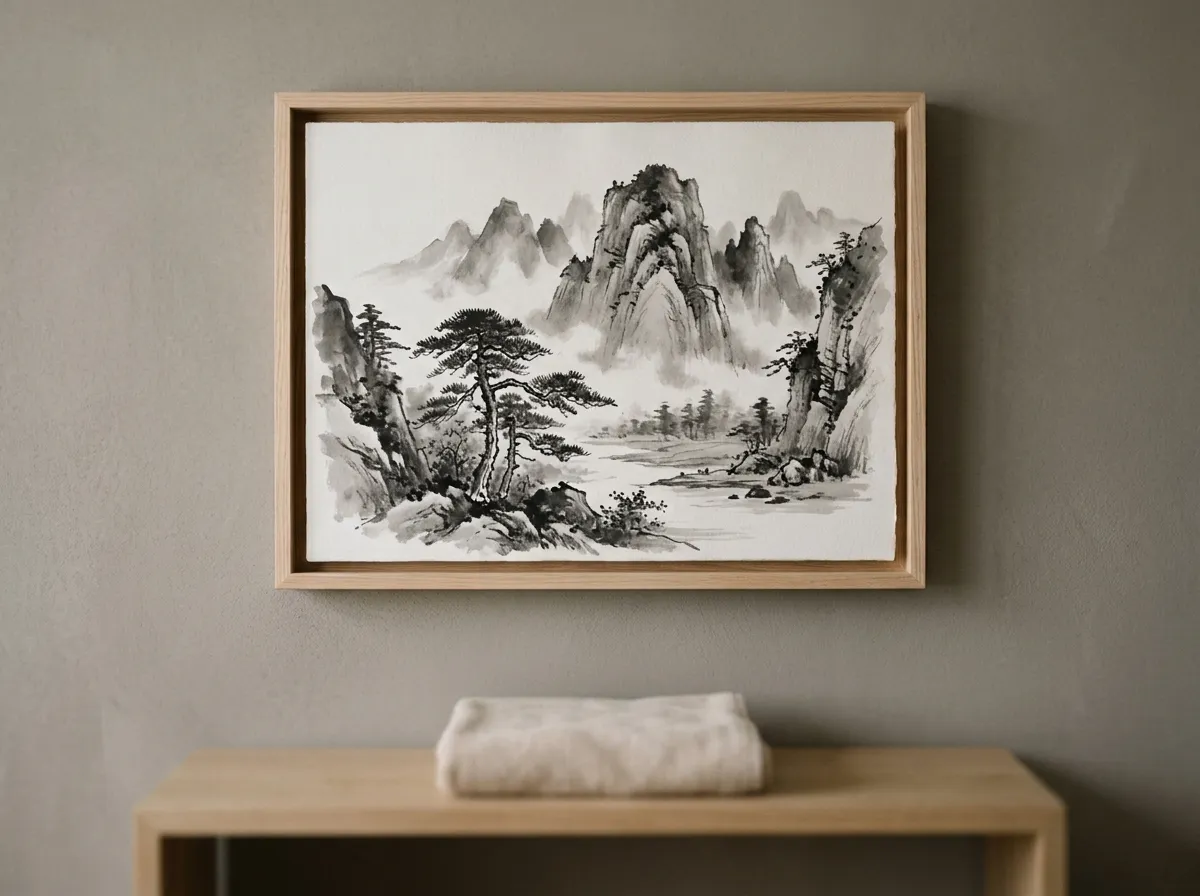
Integrating nature into a space to promote relaxation is one of the most consistent strategies in hospitality wellness design. In hotel spa and wellness contexts, biophilic hotel wall art — nature imagery in muted, restorative tones — provides the visual environment most consistent with a wellness space’s physiological goals.
Smoke & Ink Wash prints — East Asian ink brush tradition, atmospheric monochrome, significant negative space — are the technique most suited to spa environments. Their visual language is inherently meditative and reads as sophisticated under both natural and artificial spa lighting, with no colour-temperature competition against the warm natural materials typical of these interiors.
Which Technique Suits Each Hotel Space
Each MutedCanvas technique has a specific hospitality application based on its tonal character, viewing-distance performance, and behaviour under artificial light. Choosing by technique rather than by subject ensures hotel wall art performs correctly in each space’s specific conditions.
Muted Canvas — the most versatile hotel technique. Dark, cinematic, desaturated with deep tonal range. Works in lobbies, guest rooms, and corridors across every hotel category.
Gilt Edge Canvas — the premium choice. Deep midnight backgrounds with warm gold-accented edges that respond to directional artificial light. Best for upscale lobbies, restaurant feature walls, and bar back walls.
Silver Grain Film — the editorial choice. High-contrast monochrome with authentic analog grain. Works in design-led boutique hotels and corridor programmes where consistency across many prints is the priority.
Smoke & Ink Wash — the wellness and refined choice. Atmospheric, translucent, deeply calm. Best for spa spaces and rooms with a Japandi or East Asian influence.
Botanical Meadow — the approachable choice. Warm impressionist oil tones under mixed light. Best for breakfast rooms, family-friendly properties, and coastal or rural boutiques.
Scale and Placement of Hotel Wall Art at Hospitality Viewing Distances
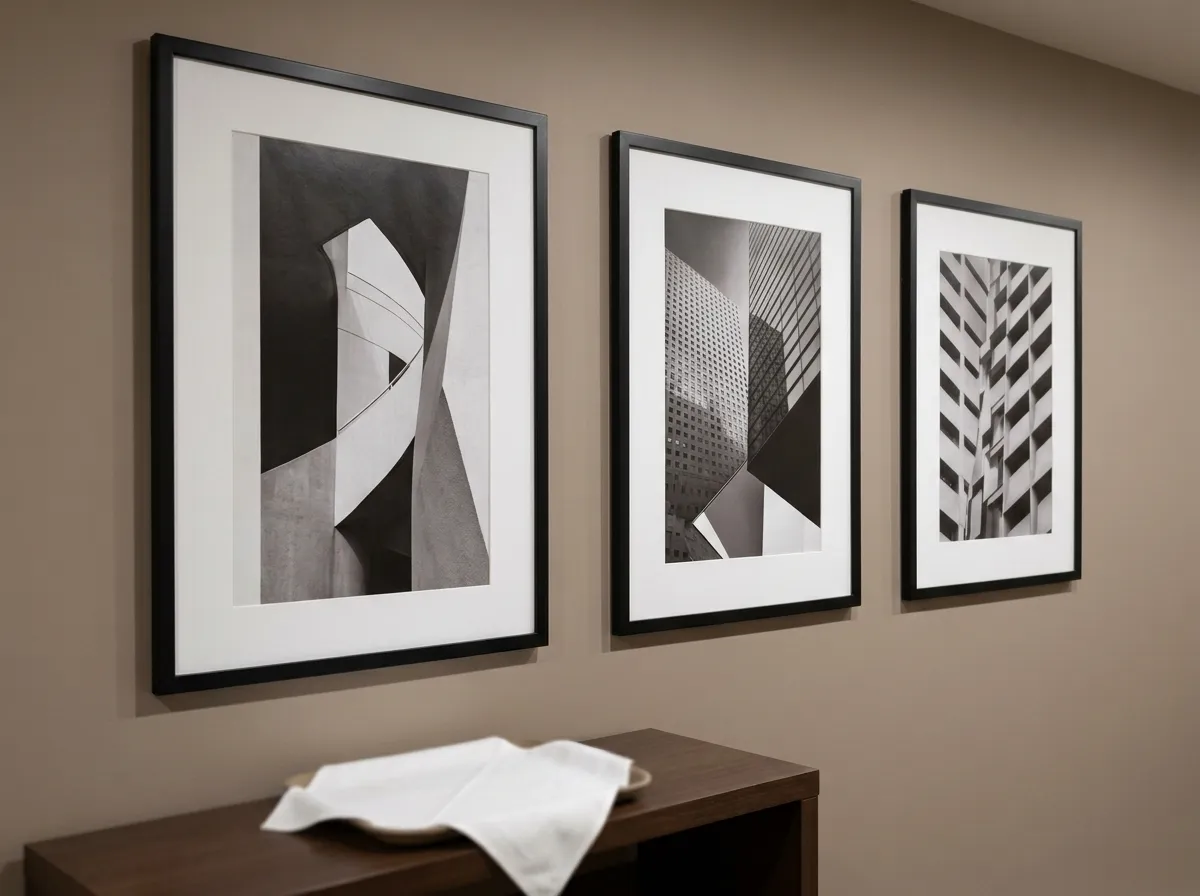
Hotel spaces are experienced at significantly greater viewing distances than residential rooms — a lobby may have guests 25–40 feet from the primary wall, a restaurant 15–25 feet, a corridor 6–10 feet in passing. Hotel wall art sized for residential distances reads as undersized and cheap in hospitality contexts.
Evaluate scale from the furthest typical viewing position, not from arm’s length. In a lobby, hotel wall art needs real presence to register as a considered choice rather than a wall detail — this is where a triptych of full-size 24×36 inch panels outperforms a single smaller piece, since every panel stays at full print quality while the total composition reaches the scale the space demands.
Hanging height follows the professional 57-inch standard to the vertical centre for all standalone positions. In dining rooms with banquette seating, lower the centre height slightly, since guests are seated for most of their experience of the art.
Hotel Wall Art That Photographs Well for Listing Images
Hotel listing photography on Booking.com, Expedia, and Google Hotel Search is the primary mechanism through which potential guests evaluate a property. Hotel wall art visible in listing photos and guest social posts functions as unpaid marketing with every view — the quality of the art communicates the quality of the property.
For photographic performance, dark-toned hotel wall art with warm tonal contrast reads better under typical hospitality photography lighting than pale prints, which wash out under warm artificial light — exactly the conditions of most hotel room photography. Gilt Edge Canvas prints photograph exceptionally well because the gold-accented edges create natural highlights that read as dimensionality.
What to Avoid in Hotel Wall Art
Generic prints in thin metal frames. A stock landscape image in a thin chrome frame is the visual signature of art chosen by price rather than quality — guests who’ve stayed in multiple properties recognise it immediately.
Identical prints in every room. This communicates efficient procurement, not considered curation. Within a consistent technique and palette family, vary the subject across rooms.
Art too small for the space. The most common and most damaging hotel wall art failure. Undersized art reads as residential scale in a hotel context — which reads as budget regardless of actual cost.
High-saturation or trend-specific art. Bright prints date rapidly and create colour conflict with warm evening lighting. Technique-based hotel wall art ages significantly more slowly.
Art hung above standard height in high-ceiling spaces. Resist the temptation. Art at 57-inch centre height reads correctly even in a lobby with a 13-foot ceiling; higher reads as inaccessible.
Hotel Wall Art by Property Type and Space
The table below maps common hotel types and spaces to the most effective techniques, sizes, and placements.
| Hotel Type / Space | Best Technique | Size | Priority Placement |
|---|---|---|---|
| Luxury boutique — lobby | Gilt Edge Canvas or Muted Canvas | 24×36″ or triptych | Primary feature wall, well lit |
| Mid-range boutique — lobby | Muted Canvas or Silver Grain Film | 20–28″ | Wall facing entrance |
| Any hotel — guest room, above bed | Muted Canvas or Silver Grain Film | 24×36″ (king), 20–24″ (double) | Centred above headboard |
| Coastal / rural boutique | Silver Grain Film or Botanical Meadow | 20–24″ per room | Bedroom + lobby feature |
| Urban design-led hotel | Silver Grain Film or Carbon Sketch | 20–24″ rooms, triptych lobby | Corridor series + lobby statement |
| Hotel restaurant / bar | Gilt Edge Canvas or Muted Canvas | 24×36″ feature wall | End wall or back-bar wall |
| Hotel spa / wellness | Smoke & Ink Wash | 16–20″ treatment room | Wall facing treatment table |
| Hotel corridor programme | Silver Grain Film series | 16–20″ portrait | Consistent height and spacing |
| Family hotel / resort | Botanical Meadow or Amber Varnish | 20–24″ per space | Lobby, breakfast room, family rooms |
Recommended Products for Hotel Wall Art
Everything you need to source, frame, and hang hotel wall art at the right scale across a whole property.
Frequently Asked Questions
Hotel Wall Art That Earns Its Place in the Guest Experience
The hotels that use art most effectively — the boutique properties that consistently attract “atmosphere” and “character” review language, the restaurants that appear in guest social posts, the lobbies guests photograph on arrival — share a consistent approach. The hotel wall art was chosen with specificity, scaled correctly, hung at the right height, and lit with dedicated warm directional light.
The cost of getting it right is modest relative to the return. Start with the lobby feature wall. Get that one right, and the rest of the property follows the same logic.
Shop Hotel Wall Art →